
Cells communicate with each other in different ways, and exosomes are one of them. They’re tiny vesicles that carry molecular information from one cell to another.
Think of it like passing a sealed note. One cell packages information into a tiny parcel and releases it; another cell can pick it up and respond to what that message contains.
That’s what makes exosomes different from familiar skincare ingredients such as vitamin C or retinol. They’re not one single active ingredient with one fixed job — they’re carriers of biological information.

Your skin already produces its own exosomes, so the idea isn’t that your skin is somehow running out of them.
Topical exosome products are used as an optional addition to a treatment when the aim is to support visible changes in skin quality — things like smoother-looking texture, more even-looking tone and an overall fresher appearance.
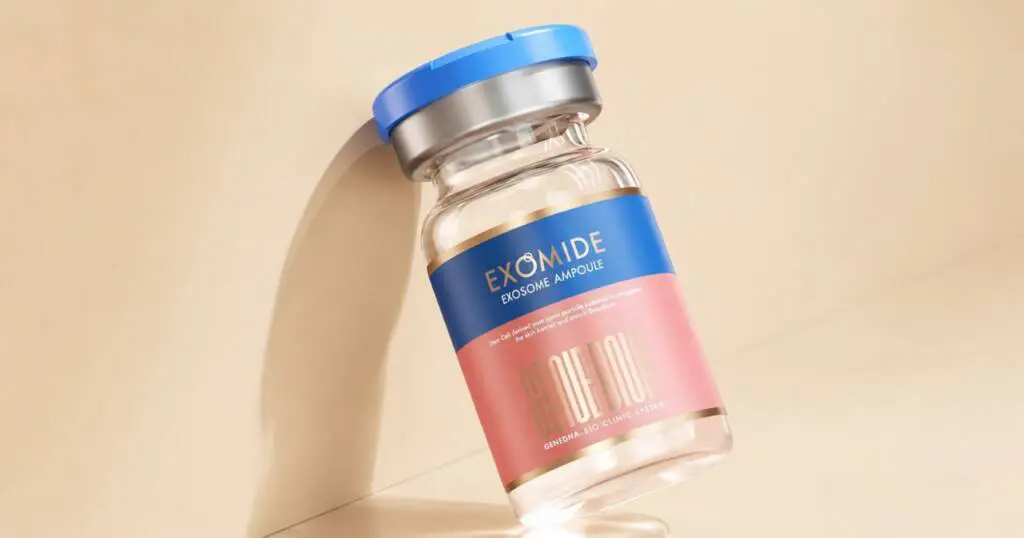
That’s also why we see Exomide as an add-on, rather than something every skin needs.
This is the fair question, because you’re paying extra.
Exosomes struggle to get anywhere on their own. Applied to intact skin, exosomes have difficulty getting through the skin barrier, so much of the product can remain on the surface rather than reaching the layers where it could be useful.
Dermal needling and Venus Viva both briefly open that door. Needling creates thousands of microchannels; Venus Viva’s nano-fractional radiofrequency creates tiny treated zones. For a short window afterwards, topicals can actually reach living cells, and the skin is already busy repairing. That window is when we apply the exosome serum.
So the roles are quite separate. The needling or radiofrequency does the work of stimulating your skin. The exosome product is applied while conditions are best for it to land — closer to fertilising a garden bed you’ve just planted than to planting it.
So what might that extra benefit actually look like in your skin?
Exosomes carry signals between cells, including signals involved in the skin’s repair response. When they’re applied after a treatment, the idea is to add another source of those signals while the skin is already actively repairing.
So what might that look like in your skin?
- softer visible appearance of fine lines;
- refined-looking texture and visible pores;
- a brighter, more even-looking complexion;
- enhanced visible tone, texture and radiance.
Human research is encouraging, although the studies are still relatively small. Results vary from person to person, so the research gives us a sense of what may be possible rather than what any one person should expect.
Not all exosome products are the same. Depending on the product, exosome-based formulations can be produced from different sources and using different technologies.
That matters because the word “exosomes” on its own doesn’t tell you everything about what’s in a formulation or how it’s intended to be used.
In our clinic, we use Exomide Skin, a topical treatment containing 5 billion exosomes. It’s applied as an additional step alongside professional skin treatments.
So when we assess an exosome product, we look at the specific formulation and how it fits into the overall treatment plan, rather than treating all exosome products as interchangeable.
With topical exosome treatments, safety depends on the product being used, how it’s handled and whether it’s appropriate for your skin.
After treatment, some temporary redness, warmth or sensitivity can occur. We’ll explain what to expect based on your skin and the treatment you’re having.
Exomide is an optional addition, and we only recommend it after assessing your skin, medical history and individual circumstances. We need to be comfortable that it’s appropriate for you before we suggest adding it to your treatment plan.
If we have any reason to think it isn’t the right choice for your skin, we won’t recommend it.
PRP and PRF use components prepared from your own blood, while topical exosome products are prepared in a laboratory from an external cell source. No blood draw, and the composition is consistent from one ampoule to the next – whereas PRP quality depends on your own biology on the day.
When the two were compared head to head in a 2025 split-face trial using radiofrequency microneedling, they performed about the same across wrinkling, pigmentation, redness and texture. Neither came out ahead.
Which makes the choice a practical one rather than a clinical hierarchy. If you’d rather avoid a blood draw, or you want a standardised product, exosomes make sense.
Exosomes may be worth considering when your concerns are things like uneven texture, tone, fine lines or supporting recovery. They’re much less useful if the problem you want to address sits outside what they can realistically influence.
And because Exomide is an additional cost, we think the benefit needs to justify it.
So we look at what you want to improve, what’s already in your skin plan and whether adding Exomide is likely to contribute enough to be worthwhile.
If we think it will add something useful, we’ll explain why. If we think your money would be better spent elsewhere, we’ll tell you that too.
Curious whether Exomide could add more to your treatment plan?
Book a consultation and we’ll assess your skin, talk through what you’d like to achieve, and explain where Exomide could fit – including what you can realistically expect from it.